
Carol on how Maggie's gave her husband Greg a voice through drumming
Monday 19 January 2026
Maggie's, Wirral
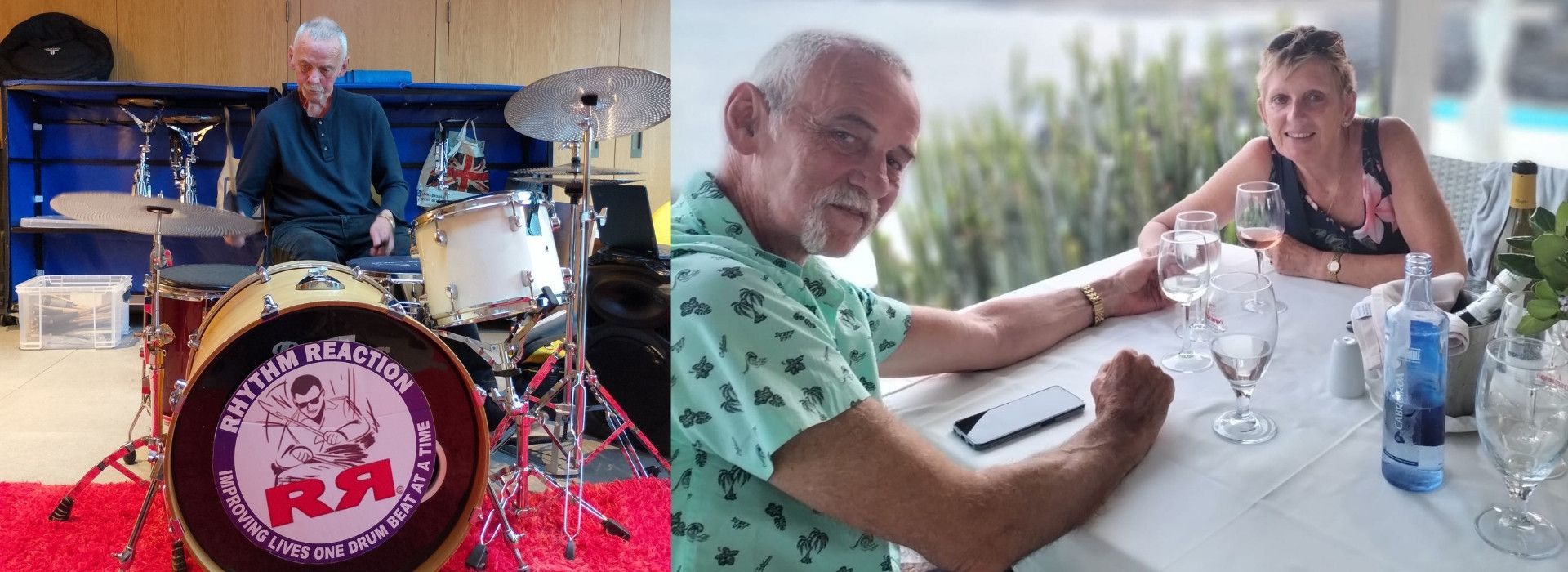
Carol talks about how Maggie's has been a refuge for their family and has given Greg a new way of expressing himself after life changing treatment for head and neck cancer.
Greg and I married in 1978. He was a navigator at sea, often away for long periods, while I was a newly qualified teacher in Bebington.
In 1980, we had our son, and Greg left the sea to join the police, which was a brave career change for him. In 1982, we had our daughter. We've lived in Prenton, Bebington, Oxton, and moved to Frodsham 16 years ago. Greg retired from the police in 2003 and became a mentor at my school, supporting struggling pupils, which he loved.
We just got Christmas out of the way in 2006, and Greg said to me, ''I've got a lump on my neck''. And you know when you're tired because it's the end of Christmas, and you just think, I just need some peace, because everybody has gone, so I was probably dismissive, and just said, ''Oh, it's just your swollen glands''.
We went to the doctors twice, and they said, we don't like a lump without pain, because he didn't have any pain at all, so they said we're going to refer you. That was in January, and it just took off from that point.
Greg's diagnosis
It was Valentine's Day when Greg was told that it was a stage four head and neck cancer in his left tonsil and the base of his tongue. At that point, your world just collapses, you just don't know which way is up.
We were at the old Walton Hospital, it was very busy, and we sat with the consultant. I remember to this day Greg saying to him ‘’how many stages are there’’? I knew the answer and thought, don't ask that question, please don't ask! Then they said, we’re going to put you on treatment, but it's going to be a bumpy ride. They went through a little bit about what to expect, like how it can affect your hearing and all the other things, but you don't listen to that. You just want somebody to say that they're going to do something.
We sat in the corridor waiting to see the oncologist with everyone passing by, and you’ve just been giving this news. Everything happened quickly after that. Greg had teeth removed due to radiotherapy potential side effects and found the PEG tube fitting traumatic. I travelled twice a day from Bebington to Aintree, managing my job and the financial burden, as both Greg and I were still working.
Greg had surgery in mid-February. They took him down in the morning, and I didn't get a call, which left me worried. I called my sister for advice and eventually went to the hospital. When I arrived, Greg was sitting up in bed with staples in his neck. A month later he began seven weeks of daily radiotherapy and three rounds of chemotherapy—one at the start, one in the middle, and one at the end. It was brutal and incredibly tough.
The impact of treatment on both Greg and I
While all this was happening, I managed to keep working for a while, but eventually, I had no choice but to go off sick and risk my job. There was no other way I could get any financial support, so I had to risk my job. I wish there was something back then aimed at speeding up access to benefits for patients, which is incredibly important. Fortunately, the school where I worked was very supportive and gave me 12 months off sick, which was crucial. I can't imagine how people go through cancer treatment alone, as it made Greg so ill.
For a couple of weeks Greg was okay, but by week three, it hit him hard. His skin was burnt, and he couldn't swallow. He was exhausted and had to start tube feeding, which was challenging. Initially, he couldn't cope with the PEG tube, but the head and neck nurse arranged for overnight pump feeding, which helped. Sometimes, the feed wasn't finished by the time we had to leave for treatment, so we'd stop it, go for treatment, then start again at home. He stayed in bed with an eye mask, unable to see or speak to anyone because he was so ill.
Late stage effects
He did brilliantly for five years. He was healthy, and his oncologist said, "Okay, we’re going to discharge you now to six-monthly appointments." Three weeks after that, the late-stage effects started to kick in, and his tongue twisted. He started to lose his ability to swallow, which was horrendous. He lost his voice due to a shrunken vocal cord. Then he experienced twitching in his face and legs, leading to a possible MND diagnosis. His swallowing deteriorated, making eating difficult. The radiotherapy seemed to have affected his receptors, so his blood pressure was very volatile and unstable. He was in hospital a couple of times because it went so high. It was difficult because he lost a lot of weight, and we had to focus on getting his nutrition back on track.
When the late effects began, he was still having treatment. During the time when Greg was having treatment, Maggie’s wasn’t here, and while Greg was having surgery and radiotherapy, I would sit for hours in the canteen by myself, I literally spent hours there alone.
His speech is very poor now, and it's quite hard to understand what he's saying. He's very tired and has a dry mouth all the time because he has no saliva. That has been an issue for him.
Finding Maggie’s for the first time
I had heard people mention Maggie's before. A husband of a lady I used to teach was treated for bowel cancer, and she would visit Maggie's. I didn't know what it was at the time. Then, about two years ago, some friends of ours, who were dealing with myeloma, suggested we visit Maggie's. They brought us there, and we had a cup of coffee and a chat with Vicky. That's how we found out about it.
I felt like someone had wrapped me in cotton wool, and you come in thinking, "It's okay, it's all right, it's okay." You feel as though you've come to a safe place with people who understand and have time for you.
I talk to Vicky or Debbie and have spoken to Kelly, the psychologist, a bit. Greg sees Kelly a lot. I also took part in the NHS engagement session and completed the mindfulness course. There's a carers course that hasn't started yet, but I'll be attending that as well.
The important thing is that Greg and I know we can come here whenever we need to talk to someone.
Shortly after we started coming, Greg was in a very dark place, and I was very concerned about him. I spoke to Debbie, and that's when he started the drumming sessions.
Drumming has been the only activity he's truly engaged with.
The team have been amazing, allowing him to attend more sessions than usual, which has kept him engaged and helped him build a good relationship with the instructor. In that sense, it's been fantastic. This place is incredible.
From isolation to connections
I usually come on Fridays with the couple who told us about Maggie’s. Greg and Phil go and drum. You come through the door and feel welcome and safe. There's a lot of responsibility when you're away from here, but as you walk through the door, you just think, "That's gone for a little while." I can relax because I know that while I'm here, he's okay.
You're always offered a drink and cake, and I usually sit and talk to my friend, Dot. She'll say what's happening with Phil, and I'll share what's happening with Greg. There’s always someone around, whether it’s Kelly, Debbie, or someone else, and they're really good at picking up when you need to say something—they just know.
We usually stay for a couple of hours and then go home, feeling grounded again, like we can go away and be all right. When Greg was really down, and he still has those times, I spoke to Debbie. She said, "When he gets like that, put him in the car and bring him here."
It's reassuring to know there's someone else who can help and make decisions about what to do for him. They're invaluable, and their knowledge is incredible. They understand head and neck cancer, and when you're talking to them, it's clear they get it.
Before Maggie’s, life felt isolating
While I can't speak for Greg, from my perspective, it was often very lonely and isolating. Our children live far away, which creates a dilemma about how much to share with them. You don't want to worry them unnecessarily, but they still need to know.
Our friends and family are kind and supportive, but they don’t completely understand. At Maggie’s, they just get it. You can share what's going on, and they respond with useful, appropriate, and positive advice. That’s the difference.
When Greg was undergoing treatment, there wasn't this kind of support. I was terrified. I've never felt fear like it, but there was nowhere to go—just sit in the hospital or go home. Had I been able to come to Maggie’s and speak to people, it would have made a massive difference.
Greg's treatment was a whirlwind that turned our world upside down. Maggie’s is a refuge, and it would have been invaluable back then. Now, it’s here for you, and they understand. They always make you feel like they have time, even though they must be incredibly busy.
Finding a Maggie’s community
There's empathy, understanding, and kindness here. Doing the mindfulness course at times can become quite emotional, but it's difficult to show that emotion outside of this place. Here, it's okay.
Both Greg and I have met people who are going through treatment, and while it might sound awful, it's nice to make those connections because people are understanding and kind. It's comforting to say, "Hi, how are you doing?" and know that they get it.
The volunteers are lovely too; we've gotten to know some of them quite well. They always ask how you are and have a chat, and the conversations aren't always about cancer. Often, we talk about life, our kids, and other things, which is nice.
Maggie’s is a refuge in many senses. It's a safe, knowledgeable, bright, and cheerful place. It's somewhere you can go and feel very safe.
Outside, life goes on around you, and you're trying to juggle everything and fight battles, but when you come into Maggie’s, it's just calm.
That calmness is so lovely and important. You see people come in who are struggling or upset, and the care they’re given is amazing. Maggie’s is special and unique.
We’re here with you
Our cancer support specialists, psychologists and benefits advisors are here for everyone with cancer, and all the people who love them.
- Come and see us at your nearest Maggie’s
- call us on 0300 123 180 or arrange a callback
- email us at enquiries@maggies.org
More stories from our centres
Show More StoriesGet cancer support near you
To find your nearest Maggie's centre, enter your postcode or town below.